
Most homeowners have never heard of hydraulic moling. They assume replacing an underground pipe means digging up their entire driveway or garden. Often, it doesn't.
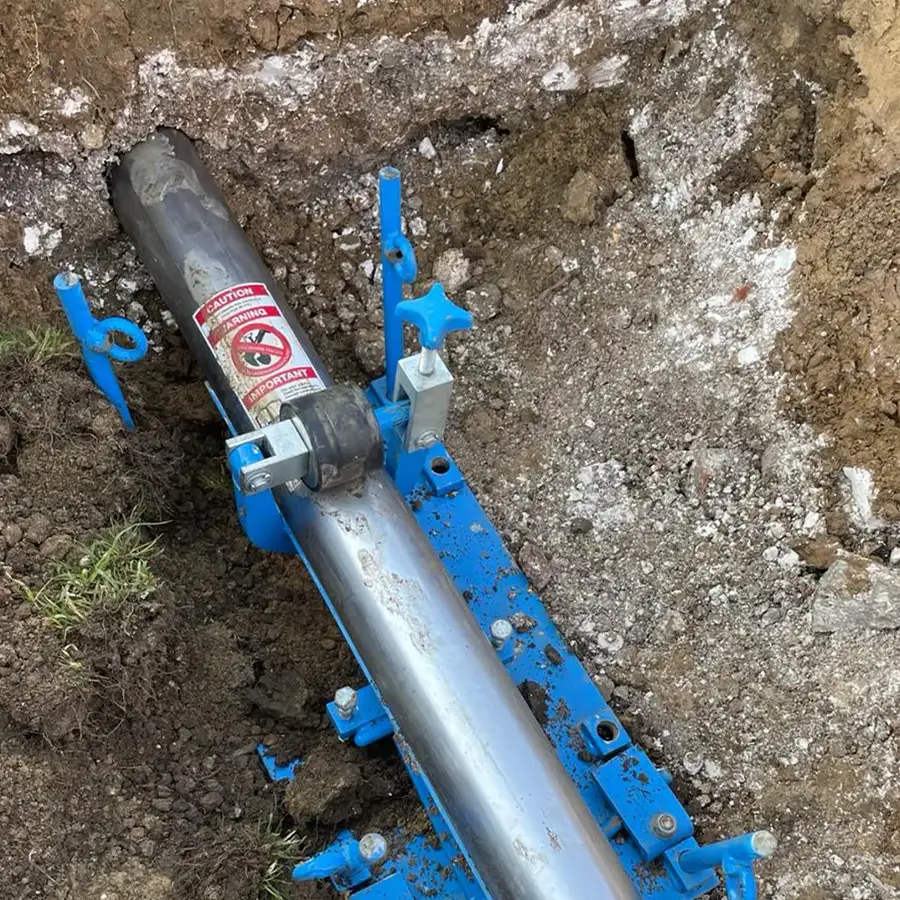
We use specialist hydraulic moling equipment to install new supply pipes underground with less excavation than traditional trenching. It's one of the most effective ways to replace a supply pipe while keeping your property intact.
How it works
- We survey the route of the existing supply and plan the best path for the new pipe.
- A small pit is dug at each end of the route, typically near the boundary and near the building.
- The moling tool is driven through the ground between the two pits, forming a tunnel.
- The new pipe is drawn through the tunnel, connected at each end, then flushed and tested.
- The pits are filled and reinstated.
The benefits
- Reduced excavation: small pits instead of a trench along the whole route
- Less disruption to gardens, driveways and paths
- Suitable for many underground pipe replacements
- Can reduce reinstatement requirements and the associated cost
- An alternative to traditional open trenching
Is it right for every property? No. Hydraulic moling isn't suitable for every property, and some excavation is always still necessary, for the pits at each end and where the pipe enters the building. Ground conditions, obstructions, other buried services and the route of the pipe all play a part. We'll survey your property and tell you honestly whether moling, trenching or a combination is the best option.
Where we use it
Hydraulic moling is often used for complete supply pipe replacements, lead pipe replacements and new water supplies, especially under block paving, tarmac drives and established lawns.